
HomeCompetitor Intelligence

Get started

Know what they shippedbefore your customers tell you.

Tracked queries watch what people say about a competitor, which keywords they hold, and how their pages change. Their capabilities are graded against your own product graph, so the comparison stays honest as both products move.

Book a demo →

Private beta

Rolling out to organizations one at a time — request access to get on the list.

Five pillars

Mentions, positioning, ads, SEO and reviews, tracked per competitor.

Ask it directly

A plain question, answered from the rows actually gathered.

Listen

What people say when you are not in the room.

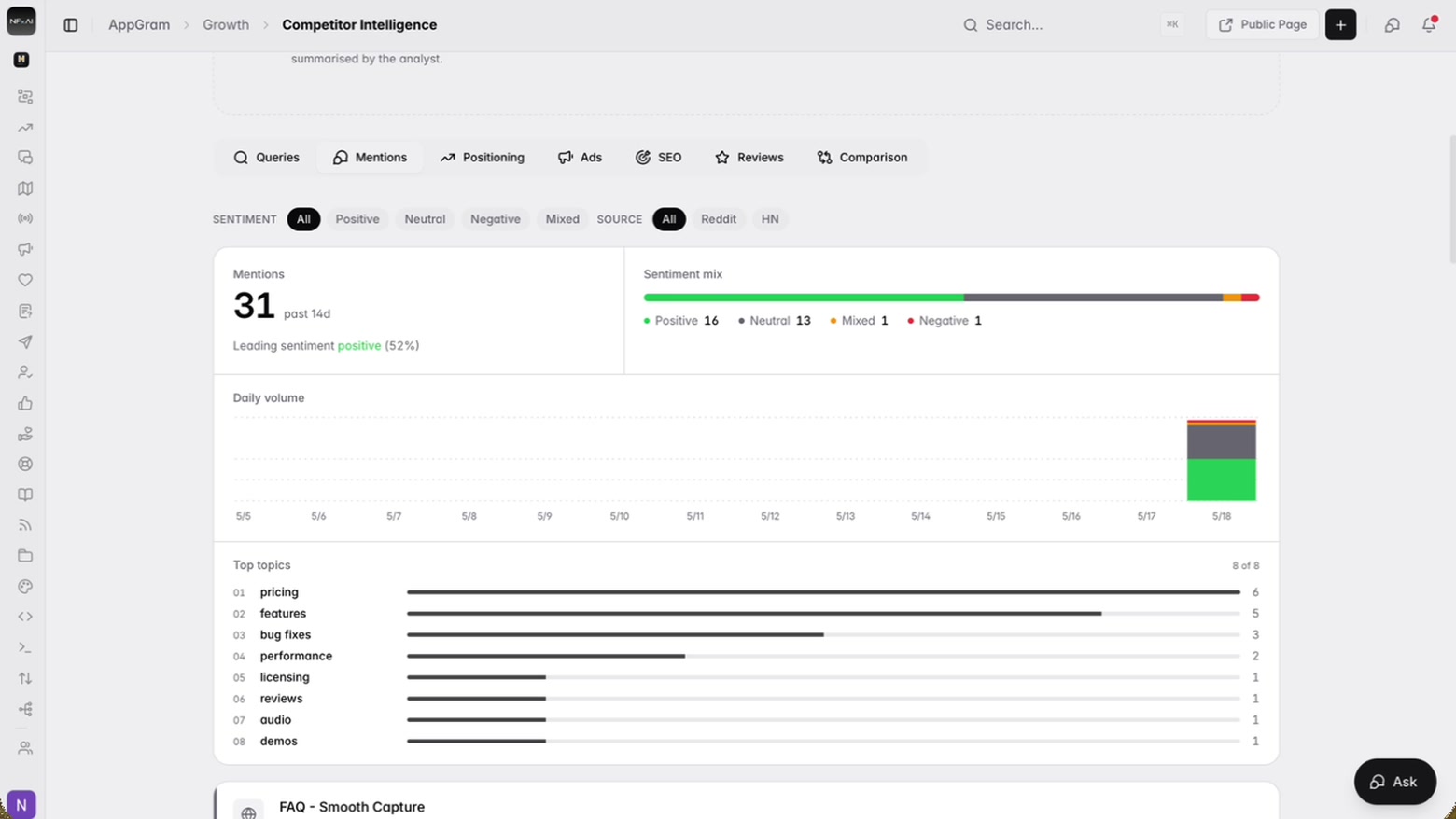
Tracked queries run against Reddit, Hacker News and web search on a schedule, and what comes back is scored and grouped. Not another feed to read every morning — a sentiment split, a daily volume and the topics people keep returning to, so the shape of an opinion is visible without reading four hundred posts.

  • Queries per competitor across Reddit, Hacker News and web search
  • Every mention scored positive, neutral, mixed or negative
  • Topics ranked by how often they come up
  • Filter to the negative ones to see what the complaint actually is
Mentions collected over a fortnight: the split between positive, neutral, mixed and negative, the volume day by day, and the topics people returned to most — pricing, features, bug fixes, performance.

Rank

Which keywords they already own.

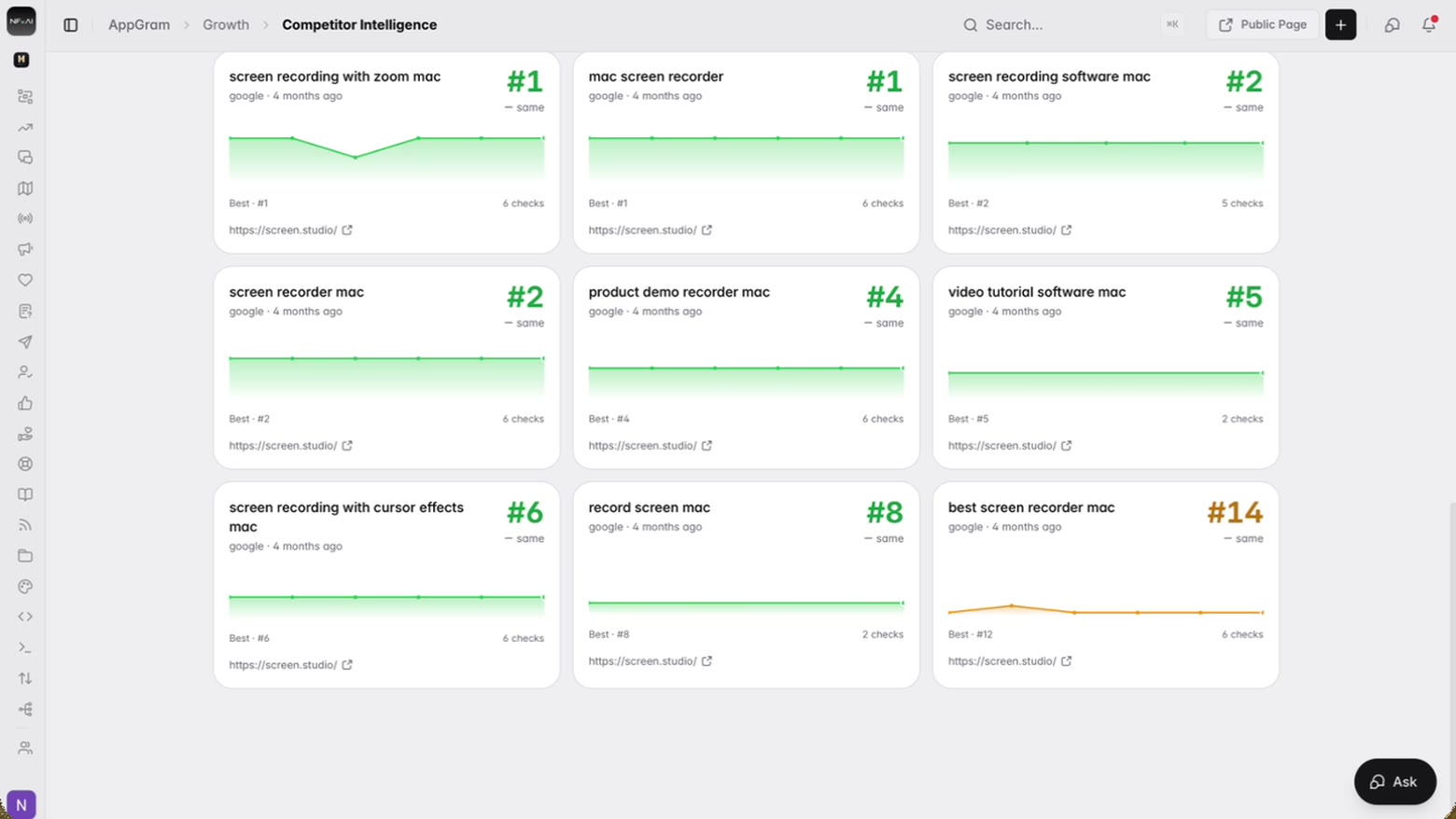
One tracked query per keyword, checked over time, with the position held and the page holding it. The change since the last check says whether it is drifting. The interesting rows are the ones you would expect to own and do not.

  • Position per keyword, and the page that ranks for it
  • Movement over time, with the change since the last check
  • Filter to what you lost entirely, or what is gaining
  • Filter to the top ten, the gainers, or what was lost entirely
A competitor’s keyword positions as cards: the rank each one currently holds, whether it has moved, how many checks are behind it, and the best position it has ever reached.

Compare

Their feature list against yours, graded.

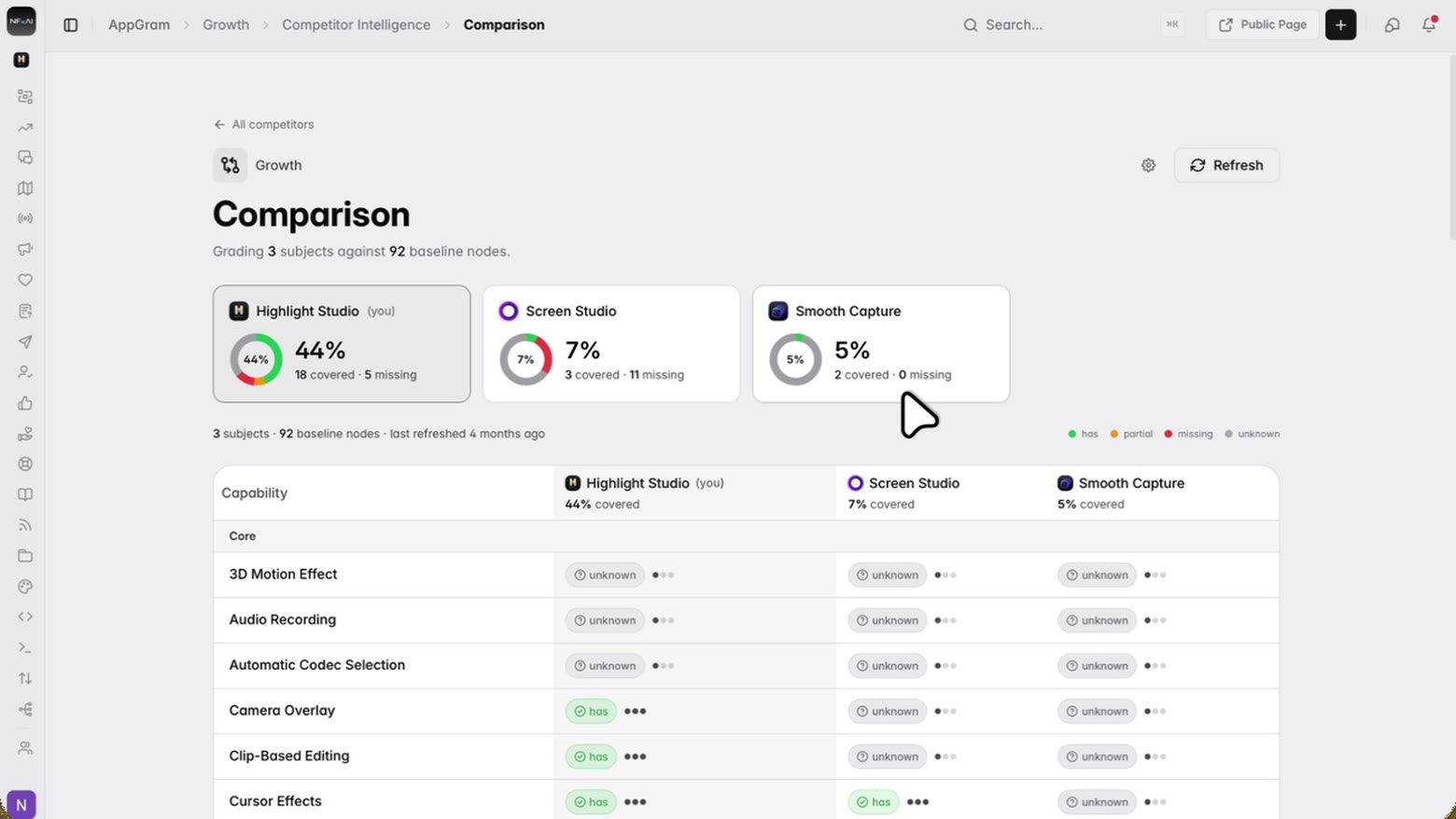
Each competitor is scored against your own capability graph — the one Mind Graph derives from your documentation — so the comparison is anchored to what you actually ship rather than to a table somebody built once and never revisited. Anything they have that your graph has no node for is surfaced separately, as a gap worth naming.

  • Graded against your own capability graph, not a hand-made table
  • Covered, partial, missing or unknown, each carrying a confidence
  • Several subjects side by side, your own product among them
  • Capabilities they have that your graph does not know about, listed as hints
A capability matrix grading several products against the same baseline graph, each with the share of it they cover, above the rows themselves marked as covered or still unknown.

Ask

Or just ask it.

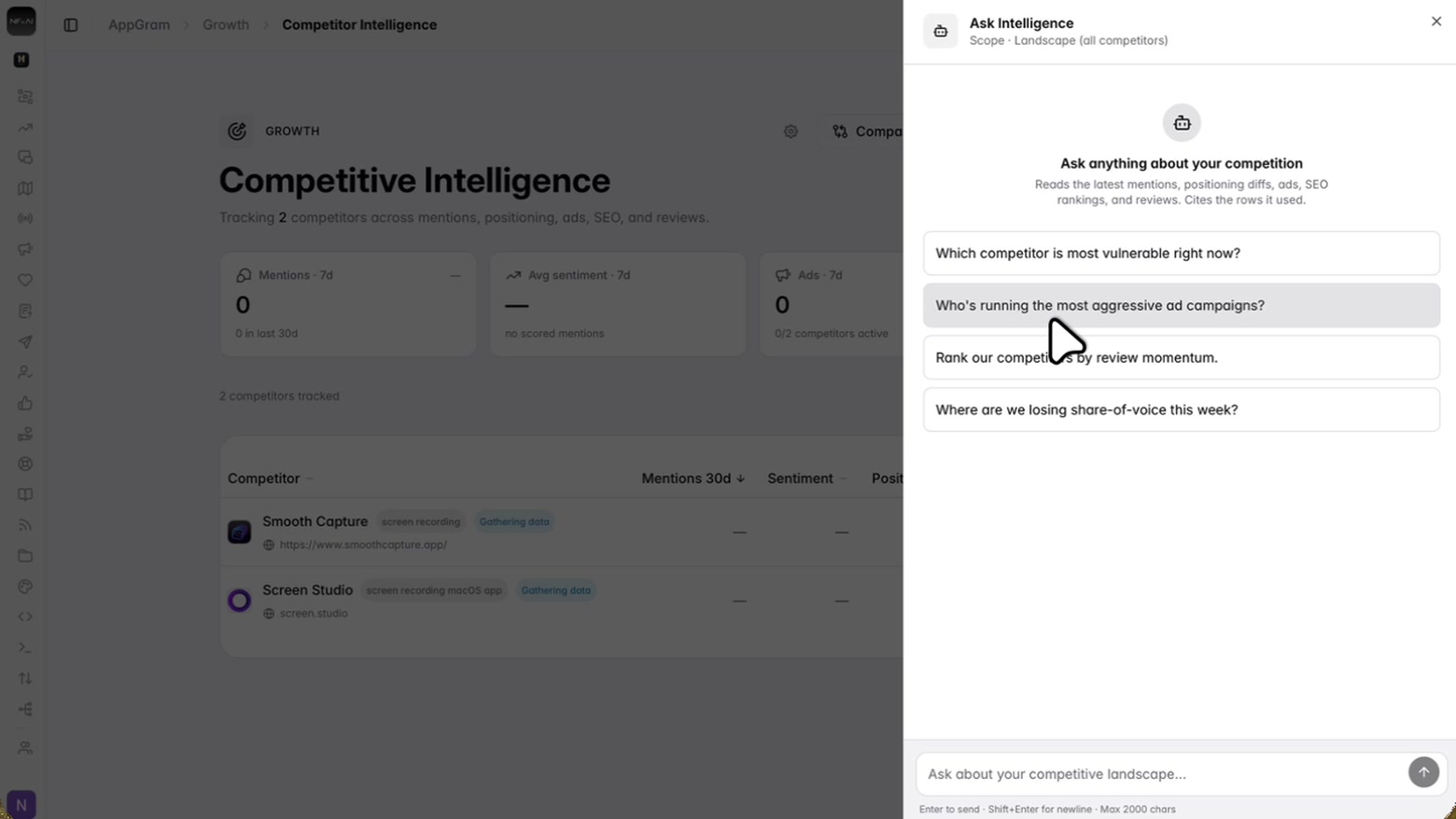
A question in plain language, answered from the mentions, positioning diffs, ads, rankings and reviews already collected — rather than from whatever a model happens to remember about your market. Useful for the questions a dashboard cannot have a widget for.

  • Reads the mentions, positioning diffs, ads, rankings and reviews it has gathered
  • Asked against the whole landscape rather than one page of it
  • Suggested questions to start from, or write your own
  • Answers in a paragraph, not another chart to interpret
The intelligence assistant open over the landscape, offering questions to start with — which competitor is most vulnerable, who is running the most aggressive campaigns — above a box to ask your own.

Who uses it

What teams actually do with Competitor Intelligence.

For founders

Know why they chose the other one

The complaint somebody posts publicly about a rival is the feature request nobody ever filed with you. Filtering the mentions down to the negative ones is the quickest read on where a competitor is actually weak.


For product

A comparison you did not have to build

Their capabilities graded against the graph of what you ship, so the table stays honest as both products move — instead of going stale the week after somebody made it in a spreadsheet.

For marketing

Watch the page, not just the product

Positioning snapshots diff a competitor’s landing pages and changelog over time, so a repositioning arrives as a described change rather than as something you notice six months late.

Connected

Competitor Intelligence plugs into everything else you run.

Every module writes to the same customer graph, so data captured here shows up wherever it is useful — no connectors to authorize, no sync to babysit.

See all integrations →

FAQ

What teams ask about Competitor Intelligence.

Where does the data come from?

Tracked queries you define, run on a schedule against Reddit, Hacker News, web search, search results and Trustpilot. Each competitor carries its own set, grouped by what they are for, and any one of them can be run by hand when you would rather not wait for the schedule.

How is the feature comparison built?

Against your own capability graph — the same one Mind Graph derives from your documentation. Each competitor is graded row by row as covered, partial, missing or unknown, with a confidence on each, so the comparison is anchored to what you actually ship rather than to a table written once and never updated.

What happens when it cannot tell?

It says unknown rather than guessing, and tells you why — usually that it has not collected enough of their pages yet. A matrix full of unknowns is a prompt to let the positioning snapshots run, not a verdict on the competitor.

What is positioning tracking?

Snapshots of a competitor’s public pages over time, diffed against each other. When their landing page changes what it leads with, or their changelog gains a section, it arrives as a described change rather than as something somebody happens to notice later.

Can we just ask it a question?

Yes. Ask Intelligence takes a question in plain language and answers from the mentions, positioning diffs, ads, rankings and reviews already collected — the landscape as actually gathered, rather than whatever a model remembers about the market.

Get started

Stop paying for six tools. Run product ops from one.

Everything you were bolting together — feedback, roadmap, changelog, help, support, status, forms — in a single workspace with one API and one bill.

Cancel anytime. Yours to test on real customers.

Talk to sales

Tell us what you're running today and we'll map it onto AppGram.

A real human replies within one business day.