
HomeAffiliate

Get started

A referral programwithout a second vendor.

Tracked links on your own domain, conversions verified against your own Stripe webhook signature, and payouts from your own PayPal balance. Your best customers already recommend you — this is where the credit lands.

Book a demo →

Private beta

We onboard programs one at a time — attribution setup depends on your Stripe.

You hold the money

Stripe for attribution, payouts from your own PayPal. We never take custody.

Nothing on trust

Clicks from a pixel, sales from your Stripe webhook, verified on signature.

Recruit

The queue decides who gets a link.

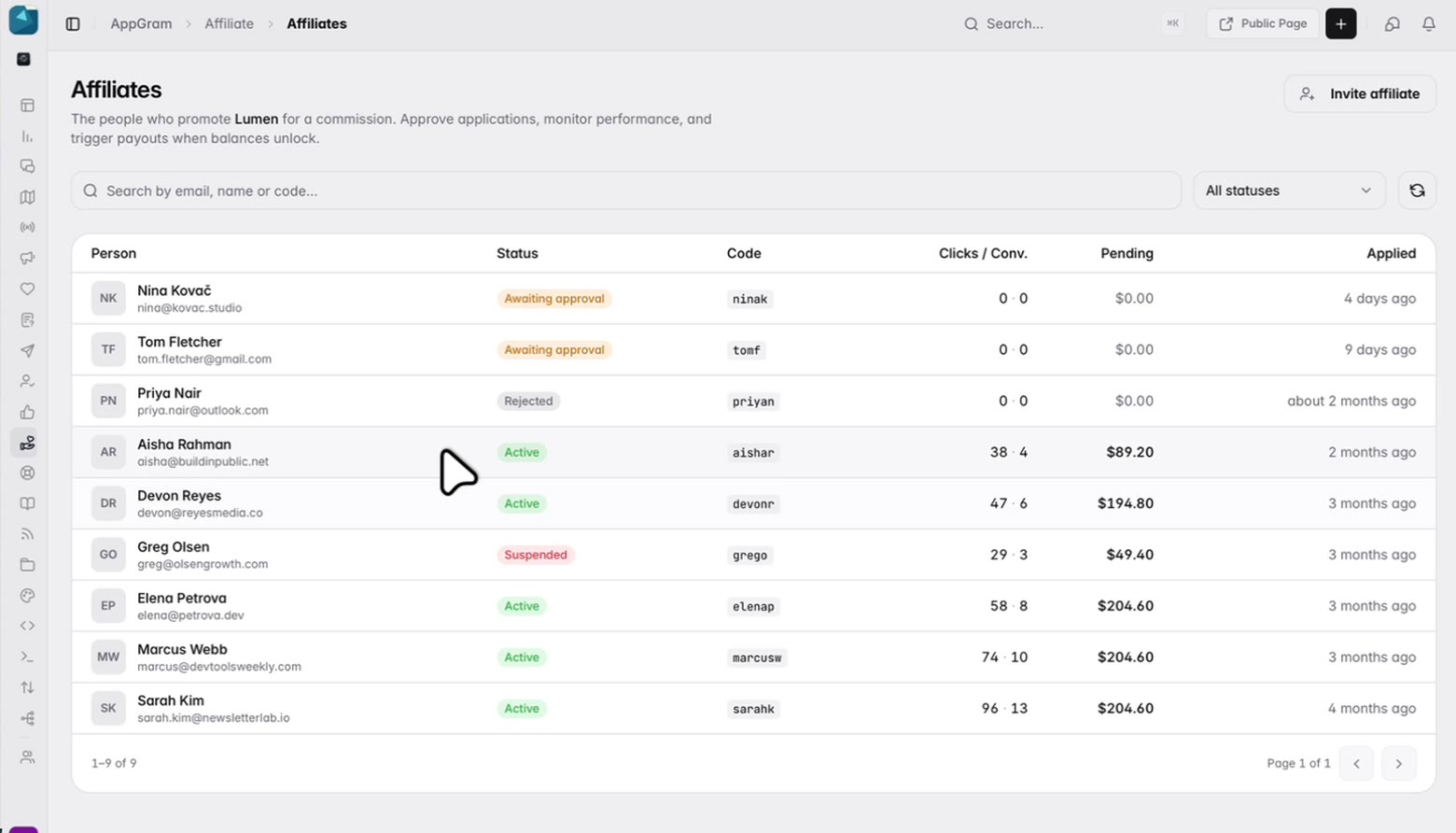
Anyone can apply; nobody earns until you say so. Applications arrive with the person, the code they want and how long they have been waiting, and approving one issues the tracked link that starts counting. Change your mind later and you can suspend them without unpicking what they already earned.

  • Applications queue for review — approve, reject, or invite someone directly
  • Awaiting approval, active, rejected and suspended, all on one roster
  • A referral code and a copy-ready tracked link per affiliate
  • Auto-approve instead, if you would rather not gate it
The affiliate roster: nine people with their referral codes, each carrying a status — awaiting approval, active, rejected, suspended — beside the clicks and conversions they have driven and the balance still owed to them.

Credit

Who gets the credit, and for how long.

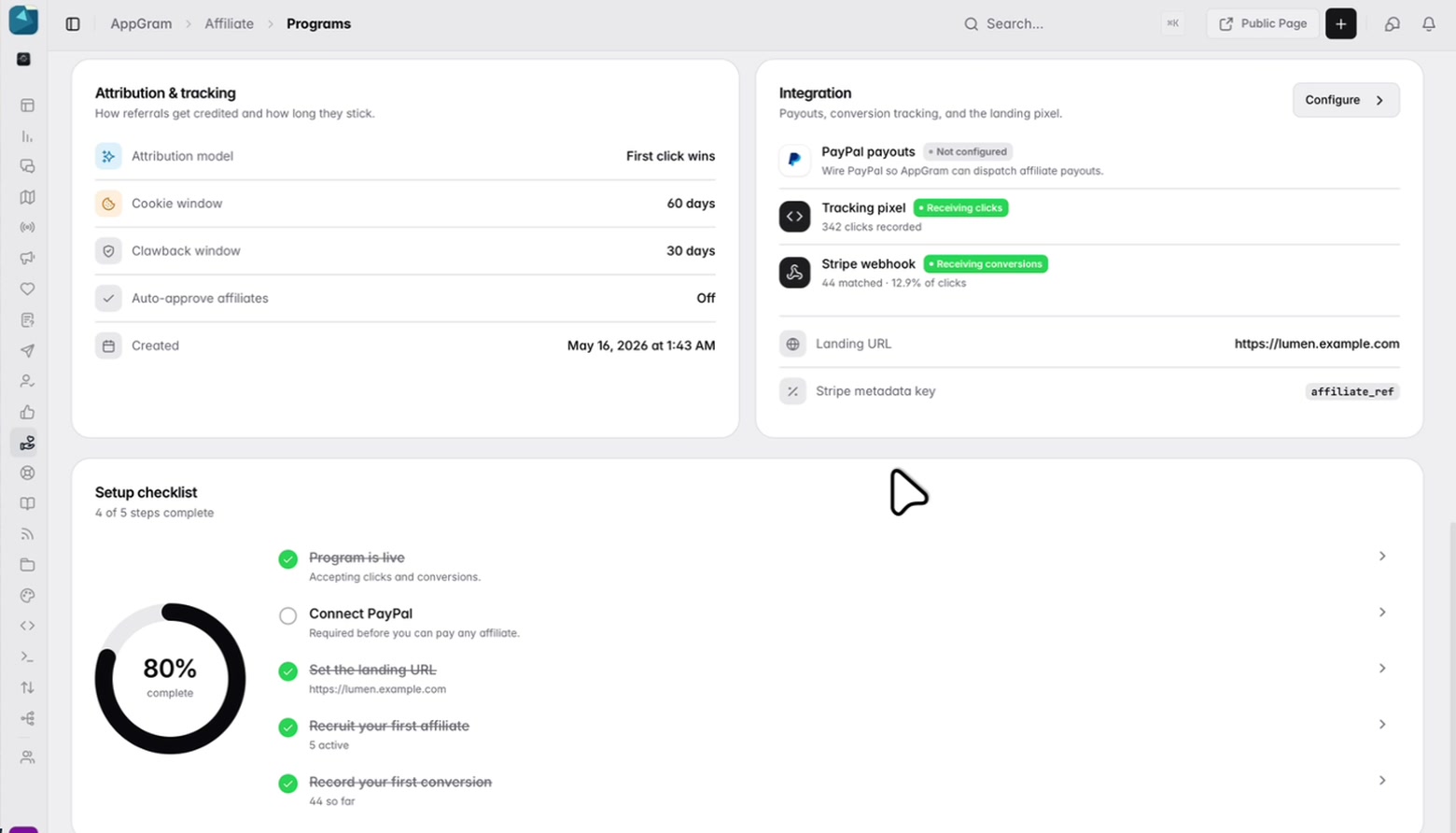
A referral is the kind of thing people argue about, so the rules are written down rather than assumed: which click wins, how long it keeps winning, and how long a refund has to take it back. Clicks come from the tracking pixel, sales from your Stripe webhook, and each one tells you whether it is actually receiving anything.

  • First-click attribution, with the cookie window set in days
  • A clawback window, so a refund can reverse the commission behind it
  • A tracking pixel for clicks and a Stripe webhook for sales, each with a live health check
  • Sales matched on a metadata key you control, not on trust
The rules behind a program: first-click attribution with a sixty-day cookie window and a thirty-day clawback, beside the tracking pixel and Stripe webhook reporting what they have received, and a setup checklist counting off what is still missing.

Pay

Balances that unlock, then move.

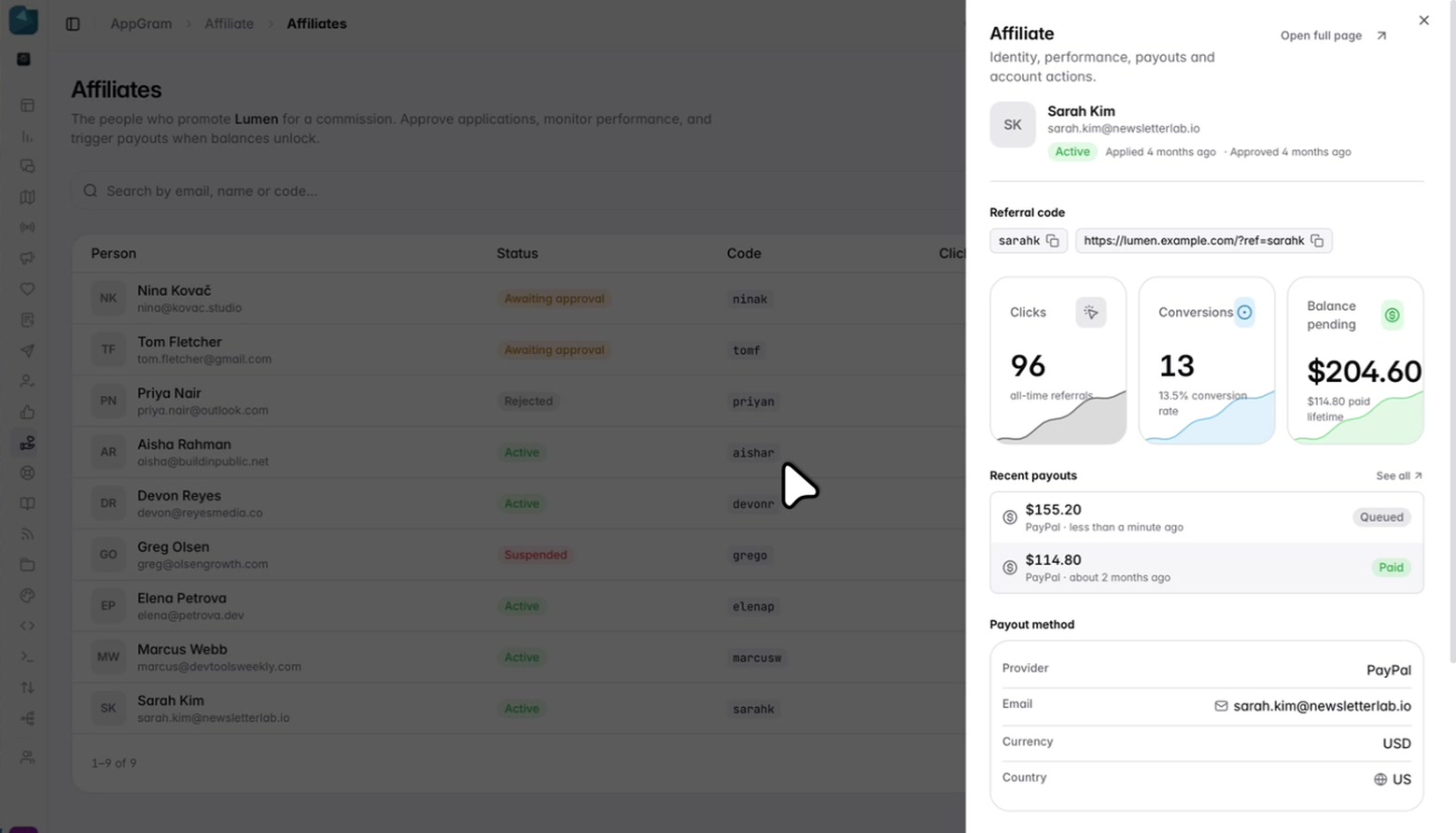
Every affiliate carries what they have earned, what is still pending and what has already cleared, with the details you need to pay them on the same record. Trigger a payout and it queues, then settles — and the history stays where anyone can check it.

  • Pending balance and lifetime paid, per affiliate
  • Payout details on the record: provider, email, currency and country
  • Trigger a payout yourself; it queues, then reports back as paid
  • A minimum payout, so nobody is dispatching three dollars
One partner’s record: their tracked link, the clicks and conversions behind their pending balance and what they have been paid over their lifetime, a payout just queued above the one already settled, and the account it will be sent to.

Watch

Whether the whole thing is worth running.

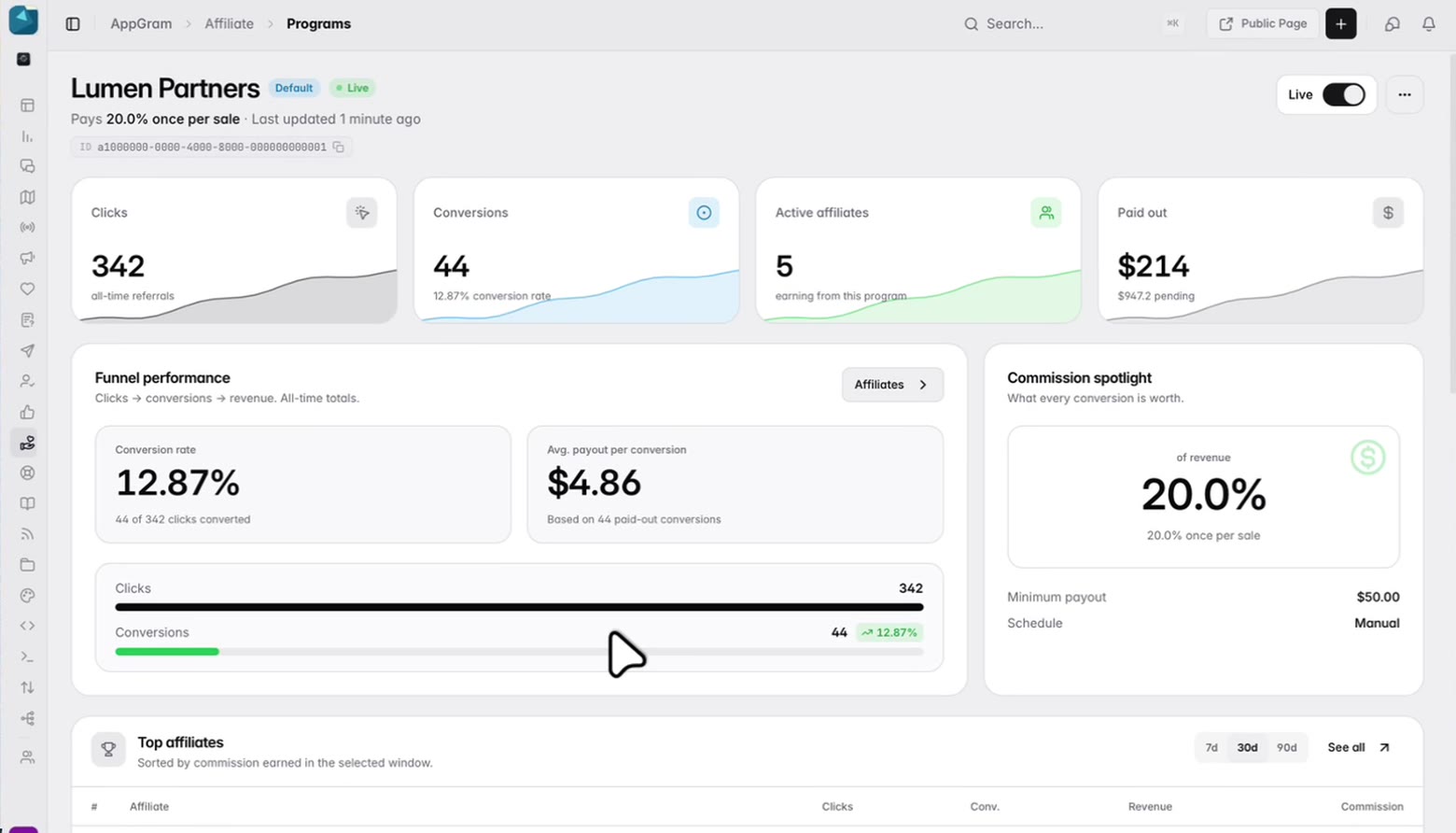
Clicks into conversions into revenue, with the rate between them and what an average conversion actually costs you in commission. The leaderboard ranks partners by what they earned over the window you choose, and when a number looks wrong there is an audit behind it rather than a shrug.

  • Conversion rate and average payout per conversion, all-time
  • Drill into any metric over 7, 30 or 90 days, by day, week or month
  • Partners ranked by commission earned in the window you pick
  • A conversion audit with every state change, searchable by id
A program at a glance: clicks, conversions, active partners and the amount paid out across the top, the funnel converting one into the other underneath, and beside it what every conversion is worth and the minimum before anything is sent.

Who uses it

What teams actually do with Affiliate.

For founders

Pay the people already recommending you

Your happiest customers are telling other people anyway. A tracked link and a percentage turns that into something you can see and settle, without hiring anyone to run it or buying a second tool to hold it.


For growth

A channel you can actually audit

Every conversion carries its own timeline from attributed to paid. When a partner asks why a sale did not count, you open the record and answer, instead of taking their word or your own on it.

For finance

Nothing leaves without a decision

Balances accrue, a minimum holds back the trivial ones, and money moves when someone triggers it. What was paid, to whom, through what account and when, stays on the record.

Connected

Affiliate plugs into everything else you run.

Every module writes to the same customer graph, so data captured here shows up wherever it is useful — no connectors to authorize, no sync to babysit.

See all integrations →

FAQ

What teams ask about Affiliate.

How does a referral actually get credited?

First click wins, for as long as the cookie window you set — sixty days in the program shown here. The click is recorded by the tracking pixel and the sale is matched by your Stripe webhook against a metadata key you control, so a commission is the result of two events lining up rather than an honour system.

What happens when a referred customer refunds?

That is what the clawback window is for. You decide how long after a sale a refund can reverse the commission behind it, and the reversal lands on that conversion’s timeline like any other state change rather than quietly adjusting a balance.

Do affiliates get approved automatically?

Only if you turn that on. By default an application waits in a queue with the applicant, the code they asked for and how long it has been sitting there, and nothing is tracked for them until you approve it. You can also invite someone directly rather than waiting for them to find the form.

How do payouts go out?

Through PayPal, against the payout details on the affiliate’s own record — provider, email, currency and country. A minimum payout holds back the small balances, and you trigger the payment; it queues, then reports back as paid, and both entries stay in that affiliate’s history.

Can we find out why one specific sale did not pay?

Yes. The conversion audit lists every state transition for every conversion — attributed, matured, paid, clawed back — filterable by event and by source, and you can paste a conversion id to open its own timeline showing what moved it, what triggered the move and the commission involved.

Can we try it without paying anyone real money?

There is a sandbox that runs on isolated data, where no payouts dispatch, no emails send and no merchant webhooks fire. Switch to it, break things, and switch back to live without touching the real program.

Get started

Stop paying for six tools. Run product ops from one.

Everything you were bolting together — feedback, roadmap, changelog, help, support, status, forms — in a single workspace with one API and one bill.

Cancel anytime. Yours to test on real customers.

Talk to sales

Tell us what you're running today and we'll map it onto AppGram.

A real human replies within one business day.