 appgram Kernel
Bring your customer stack home. One engine, in your cloud.
AppGram Kernel puts events, customer profiles, live segments, journeys and AI agents in one engine, on infrastructure you control. It is the engine AppGram itself runs on, and nothing your agents write goes out until a person approves it.
The problem
Every enterprise rebuilds the same stack.
Customer data in one vendor, journeys in a second, AI in a third, scripts in between. Every new idea waits six weeks for the plumbing, and the bill arrives either way.
Kernel is all of it. One engine, one record, one deployment that is yours.
How it works
One engine, from the first event to the last approval.
An event lands on the customer's record, the record puts her in a segment, and the segment starts a journey that waits, branches, lets the AI draft from your own articles and stops for a person.
Automation
You build the flow. We run it.
Queues, cron, workers, retries, state, monitoring: the plumbing that kills most automation ideas is the engine's job. Your team writes the one step that is actually your business.
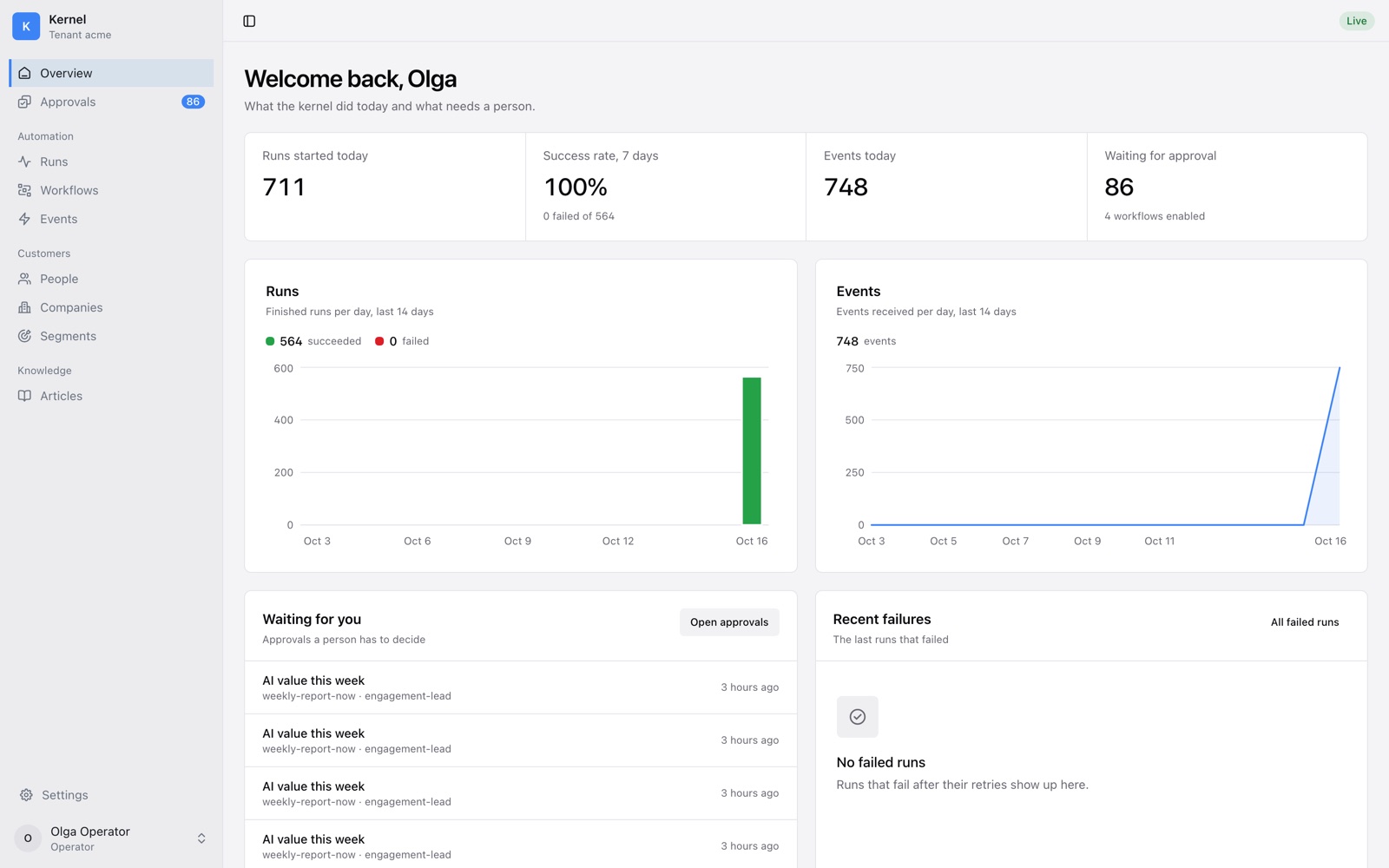
What ran today, and what needs a person.
Runs, success rate, events and the approval queue on one screen, for the operator who answers for all of it.
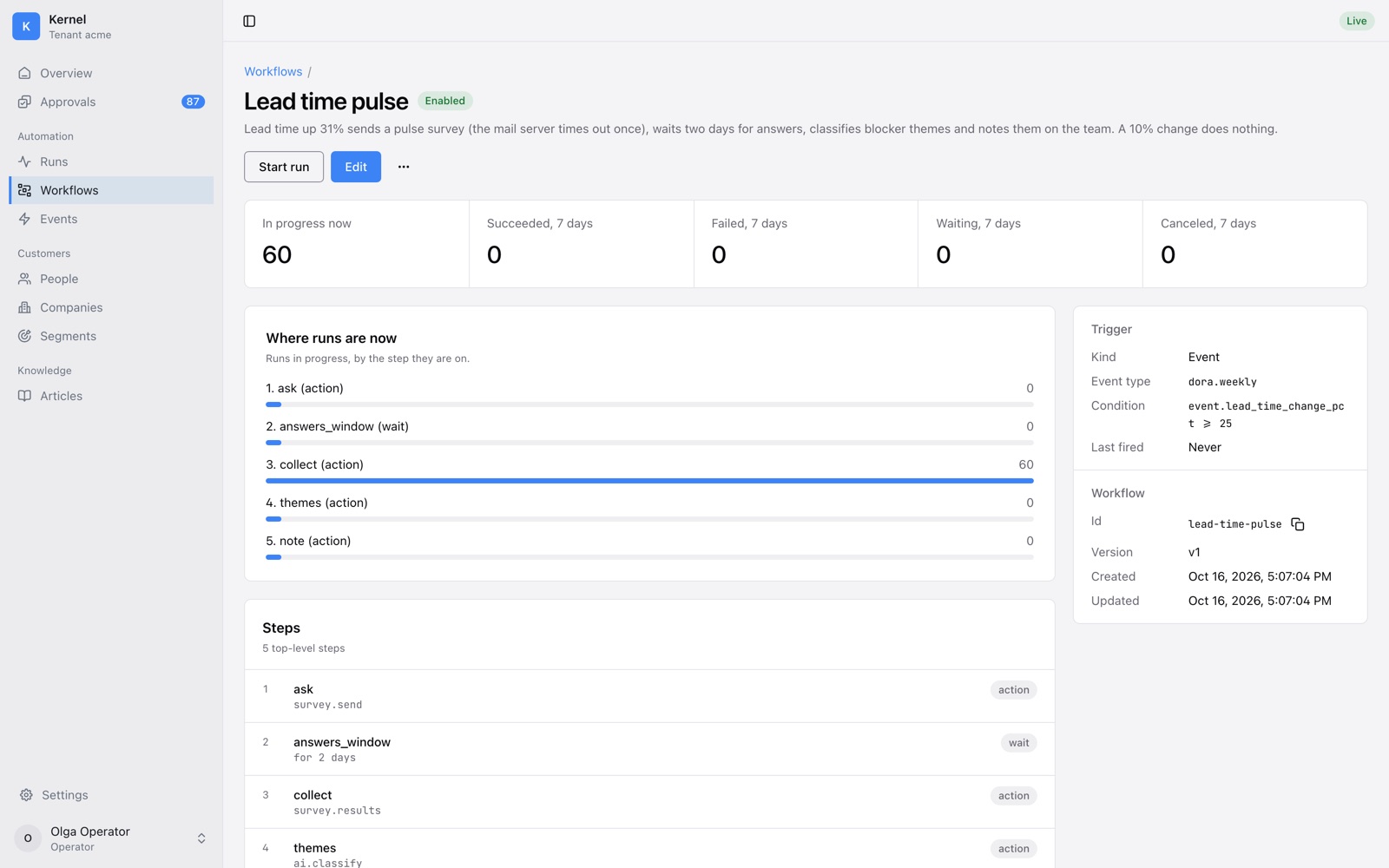
Every journey shows where its customers are.
In progress, succeeded, waiting, failed, and how many people sit on each step right now. Triggers by event, schedule, webhook or hand.
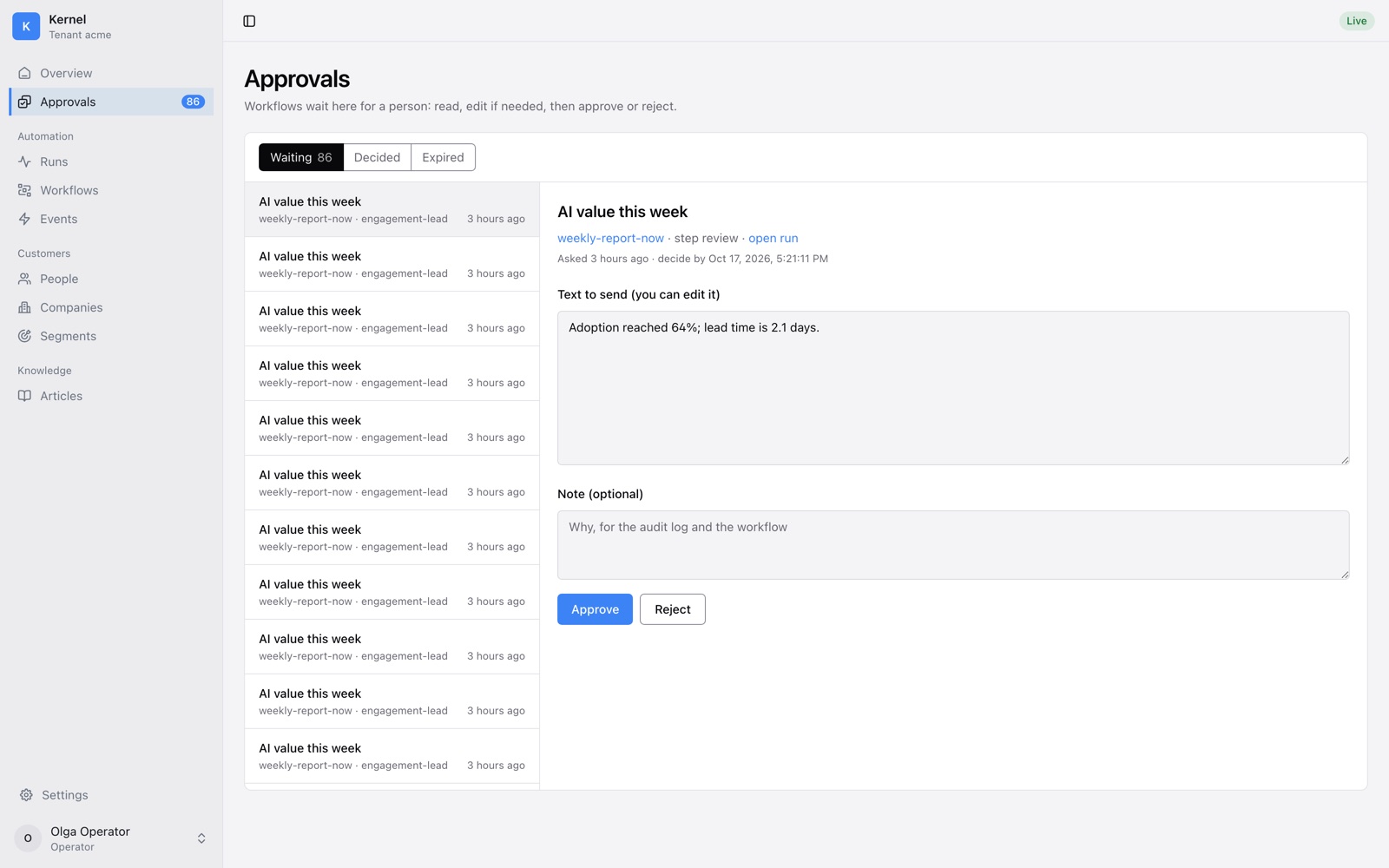
The AI drafts. A named person sends.
Reviewers read the draft, edit it if needed, leave a note for the audit log, then approve or reject. First decision wins.
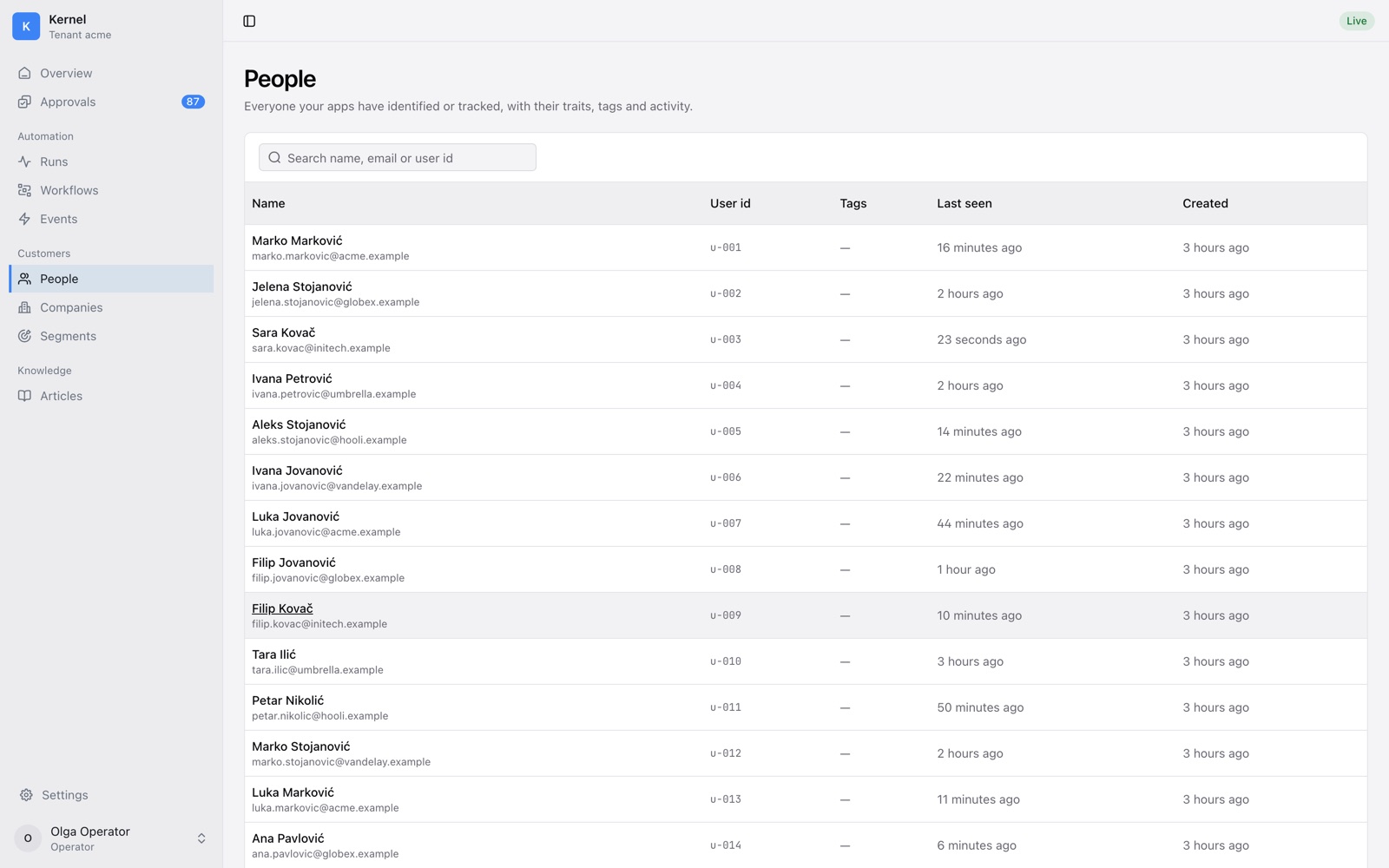
Every person your apps know, one record.
Traits, tags, companies and a timeline of everything they did. Anonymous and signed-in ids merge on their own.
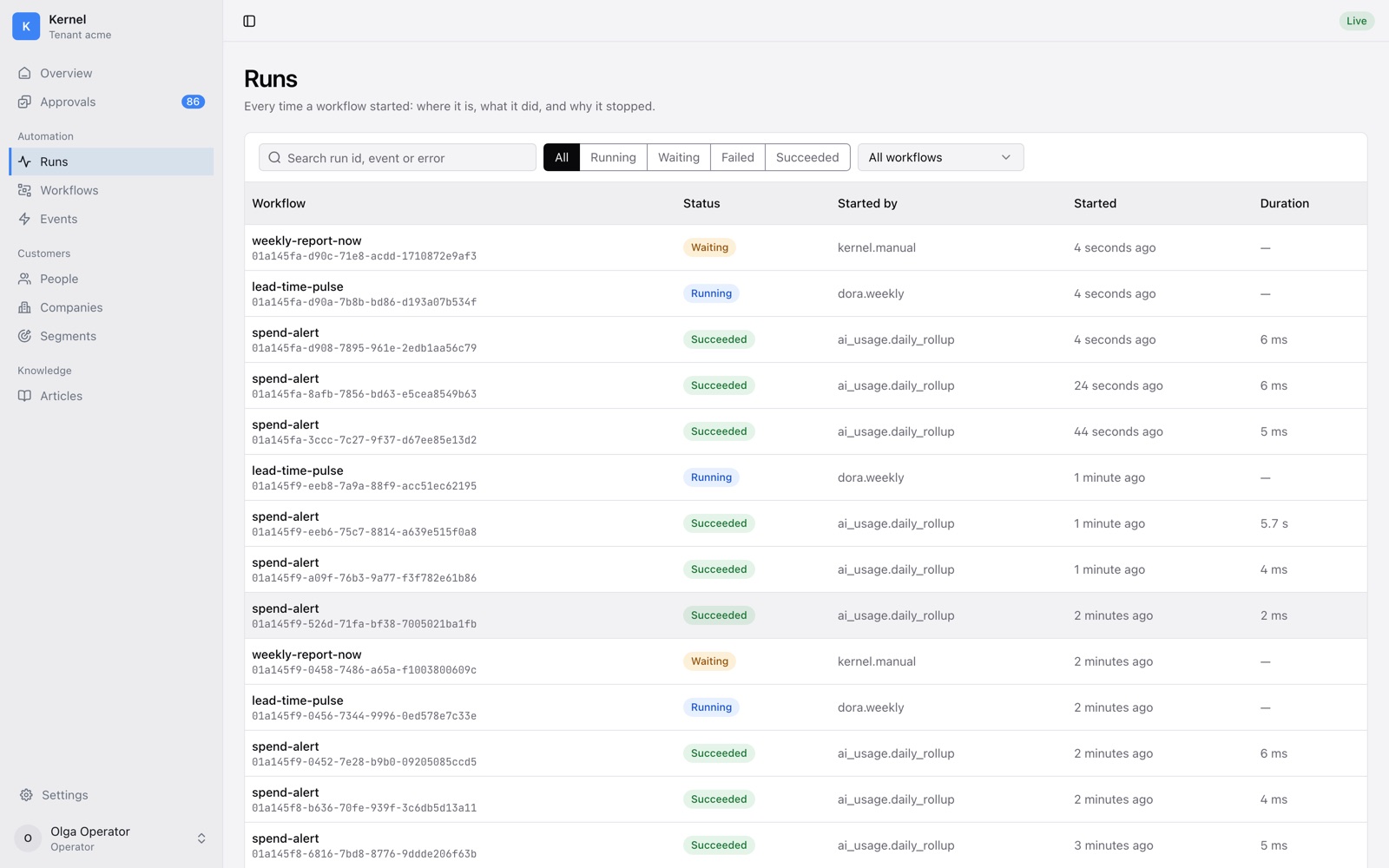
Every step, explained.
Search runs by status, event or text, open any one and read its per-step log. Live over server-sent events.
Governed agents
Let AI act. Keep a human on the button.
Your agents reach customer data, segments, journeys and knowledge over MCP. Reads go straight through. Anything that changes something waits for a person, who can edit it before it goes.
- 21 MCP tools, scoped per agent key
- 0 writes an agent can approve for itself
- SSO identity on every signature in the audit chain
Deployment
One namespace in your cluster. Every control your security review asks for.
Helm into Kubernetes, or a dedicated server in your account. Your Postgres holds the data, your KMS holds the keys, your identity provider decides who gets in. Releases are signed, and migrations only ever add.
SSO you already run
OpenID Connect and SAML 2.0. Tested against Keycloak and Entra.
SCIM 2.0
Entra, Okta, OneLogin, JumpCloud. Remove someone in the directory and the next request fails.
Keys in your KMS
AWS KMS, GCP KMS, Azure Key Vault or HSM, Vault Transit. Revoke the key and the kernel stops.
Tamper-evident audit
HMAC hash chain, shipped to Splunk HEC, syslog over TLS, S3 Object Lock or any HTTP collector.
Signed releases
Cosign keyless signatures, an SPDX SBOM and SLSA provenance on every image.
Offline licence
Ed25519, verified on the box. A 14-day grace period, never a kill switch over the wire.
GDPR by endpoint
Export and erase per person, retention per tenant, and an allow-list for outbound hosts.
Ten key scopes
From ingest-only to fleet. Every route in the OpenAPI spec names the scope it needs.
Why now
Every market now asks where customer data lives. Have one answer.
For your engineers
Five SDKs, every endpoint. Or keep the Segment library you have.
Official SDKs for TypeScript, Python, Go, .NET and Java, covering all 108 API operations. Already on Segment? The kernel speaks its tracking API, so your existing library just points at your own host.
- Events as JSON or CloudEvents 1.0, deduplicated by id
- Schemas per event type, enforced when you want them
- Outbound webhooks signed to the Standard Webhooks spec
- Prometheus metrics and a live event stream
The pilot
Sixty days. One journey, live.
Pick the journey that hurts most and we put it in production with you, on your infrastructure.
Is this the same engine AppGram runs on?
Yes. Feedback, support, help centre and automations in AppGram sit on the kernel. Kernel is that engine, packaged to run on infrastructure you own, with the enterprise controls a regulated buyer asks for.
Where does it run, and who operates it?
In your Kubernetes cluster through the Helm chart, or on a dedicated server we provision with Terraform. Both live in your account. We ship signed releases, and upgrades roll out ring by ring with automatic rollback on the dedicated install.
Does anything leave our network?
No. The kernel never calls AppGram, and the licence is verified offline. The only outbound traffic is what you configure (your webhooks, your model provider, your audit sink), and an allow-list limits which hosts it may reach.
Which AI models does it use?
Yours. Answers come from Anthropic or any OpenAI-compatible API, self-hosted models included; embeddings from OpenAI-compatible APIs, Gemini or Vertex AI. When no relevant article is found, the model is never called.
We already use Segment. Do we start over?
No. The kernel speaks the Segment tracking API (identify, track, page, screen, group, alias and batch), so you point your existing Segment library at your own host and keep shipping.
What about certifications?
Kernel is not SOC 2 or ISO 27001 certified itself. What we hand your CISO is a security pack mapping every kernel control to both frameworks, so it slots into the audit you already run on your own infrastructure.
appgram Kernel
Events, CRM, segments and automation. On your infrastructure.
Dedicated. Signed. Yours.